
Teams usually do not start looking for a Hotjar alternative because they suddenly dislike heatmaps or replay. They start looking when the workflow around those tools becomes slower than the problems they need to diagnose.
That often happens in growing SaaS teams with several high-intent journeys to monitor at once. The team can still collect recordings, but the path from “we know something is leaking” to “here is the exact behavior pattern and the next fix” starts taking too much manual review.
This page is for teams in that moment. It explains when Hotjar is still enough, when it starts creating workflow drag, and how Monolytics changes the investigation path for replay review, research prompts, and targeted surveys.
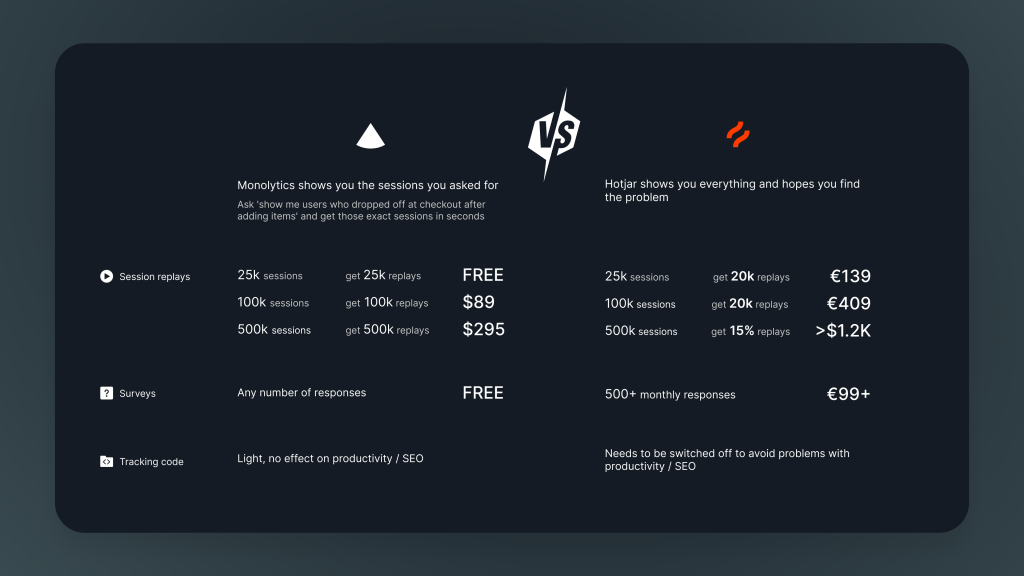
When Hotjar is still enough
Hotjar can still be a reasonable fit when the team mostly needs lightweight heatmaps, a manageable replay sample, and occasional feedback on one marketing site or one relatively simple product flow.
If the main jobs are exploratory page review, simple scroll/click inspection, and one-off checks by a small team, switching tools may not be the first improvement to make. In that scenario, clearer page strategy or better experiment discipline may matter more than replacing the platform.
When teams start looking for a Hotjar alternative
The switch question becomes more serious when the issue is not data collection but workflow friction. Teams often hit this point when they can see that users are dropping or hesitating, yet still need too much manual work to isolate why.
- Replay review is too broad, so the team still watches random sessions before finding the relevant ones.
- The question is pattern-based, but the workflow is still session-by-session instead of prompt-to-pattern.
- Surveys are useful, but the team wants them tightly connected to the friction step rather than managed as a separate budget or side tool.
- Several high-intent flows need investigation at once, so evidence-to-action handoff becomes the real bottleneck.
A 3-question switch checklist
A good alternative decision is less about feature count and more about whether the investigation workflow fits the way the team actually works.
- Can your team isolate the failed sessions fast enough? If not, the bottleneck is probably the search and review workflow, not replay itself.
- Can you move from observed friction to repeated pattern detection without manual filter building? If not, the tool may be slowing diagnosis at the exact point where the team needs speed.
- Can you connect visible friction to targeted feedback without extra operational drag? If not, the workflow is likely too fragmented for a growing product team.
Where Monolytics changes the workflow
1. Targeted replay review instead of broad replay sampling
Monolytics is strongest when the team already knows which journey matters and needs to inspect the right evidence quickly. That is where Monolytics Records becomes useful: start from the failed step, narrow the session subset, and review only the sessions tied to that outcome.
2. Pattern detection from natural-language prompts
When the problem is broader than one route, Monolytics Research helps the team move from “show me the sessions where users hesitate before submit” to a repeated behavior pattern without hand-building every filter first.
3. Targeted surveys tied to the friction point
If the behavior is visible but the reason is still unclear, Monolytics Surveys makes more sense when it is attached to the exact page or step where users lose confidence. That keeps the qualitative signal closer to the moment that needs explanation.
Continue in Monolytics
If the team already knows the workflow gap, move from the article into the product surface that matches the investigation job instead of restarting the diagnosis from scratch.
- Continue in Monolytics Records when the team needs targeted replay review on one failed journey.
- Continue in Monolytics Research when the team needs repeated-pattern analysis across many failed sessions.
- Continue in Monolytics Surveys when the missing signal is the user’s stated reason, not just the observed behavior.
Who should switch now
- Growing SaaS teams investigating several high-intent flows at once.
- Teams that already know replay matters, but need a faster route from evidence to fix.
- Operators who want one workflow for targeted recordings, repeated pattern analysis, and short feedback capture.
Who should probably stay on Hotjar for now
- Teams using it lightly on one simple site with low review volume.
- Teams whose real constraint is not tooling but unclear ownership or weak experiment follow-through.
- Teams that mainly need lightweight visual page checks and are not yet hitting workflow friction.
Final takeaway
The best Hotjar alternative is not the tool with the longest feature list. It is the tool that shortens the path from visible drop-off to a confident next fix. If the real pain is manual session hunting, weak pattern detection, or disconnected feedback workflows, that is the point where Monolytics becomes worth considering.
Related replay and comparison guides
If the team is already comparing replay tools, the next useful move is to narrow the comparison to the workflow that still feels unresolved instead of re-reading generic feature matrices.
- FullStory alternative for growing SaaS teams when the real question is session replay depth versus operating speed and review overhead.
- Heatmap guide when the team still needs to separate attention problems from replay-review problems.
- Continue in Monolytics Records when the next step is to review failed high-intent sessions directly.